Voice control for the Atari 2600

Say "left". The Atari sees a joystick move.

Hey Stella listens for a handful of words and works the joystick for you. It plugs into the joystick port, so the cartridges you already own work unchanged. The parts cost about US$10 and there is no custom circuit board.

pipx install "heystella[all]"

Source on GitHub PyPI

Early days. The software runs on a computer today. The dongle is designed and not yet built, and nothing has been tested on a real console.

Try the Pitfall! profile

joystick: released

This runs in your browser and nothing is listening. It follows the same rules as the real program.

How it works

  1. You speak

    A microphone on your computer hears you. Recognition runs offline, with no account and no cloud service.

  2. A profile decides

    Each game has a short text file of words. "Jump" is the fire button in Pitfall! and something else in another game.

  3. The dongle presses

    A small board and five transistors pull the joystick pins to ground, the same as a switch closing inside a joystick.

  4. The console cannot tell

    To the 2600 it is an ordinary joystick. No cartridge changes, no console modification.

No console? The same program presses keys in the Stella emulator instead.

What works today

Host programWorksHears recorded speech and typed phrases and turns them into joystick actions. Not yet tried with a live microphone.
RecognitionTested58 of 60 phrases right across US, British and Australian synthetic voices. The two misses were one word, now removed.
Token test ROMWorksReads all 255 token values correctly in an emulator, on NTSC and PAL.
Game profilesDraftsFive starter profiles. None played by a person yet.
DongleNot builtWiring and parts list are written. No firmware yet.
Real consoleUntestedNothing has been plugged into a 2600.

Add your game

A profile says what each spoken word does in one game. Writing one needs no hardware and no programming. Copy the template, list your words, and check it with one command.

Words should be short, common and sound different from each other. Made-up words do not work, because the recogniser looks words up in a pronunciation dictionary.

Profile guide

[game]
title = "Space Invaders"

[profile]
author = "your-name"
mode = "joystick"

[words]
left  = { hold = ["left"] }
right = { hold = ["right"] }
stop  = { release = "all" }
fire  = { tap = ["fire"], aliases = ["shoot"] }

Build the dongle

A 2600 joystick is five switches, and a game reads them about 60 times a second. Any hobby board on a breadboard keeps up, so there is nothing here to send to a factory.

The transistors matter. The joystick lines sit at 5 volts and the board runs at 3.3, and with transistors an unplugged dongle looks like a joystick nobody is touching.

Nobody has built one yet. Treat the list as a plan until the first one works.

Wiring and parts

ESP32-S3 dev boardUS$6 to 9
5 NPN transistors and 5 resistorsunder $2
9-pin joystick extension cable, cut in half$3 to 5
Breadboard and wires$3
I2S microphone, for running with no computer$2 to 3, later

Writing a homebrew game?

A game can receive more than joystick moves. In data mode the dongle will send one byte per spoken word over the joystick port, so your game can tell "ember" from "frost".

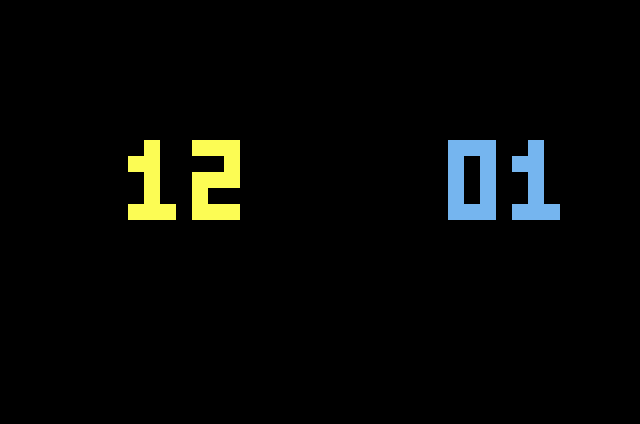
The reading routine is 81 bytes of 6502 and six bytes of RAM. It ships with a test ROM that shows the last token and a running count.

Spell Caster, a wizard duel you play by speaking, is the planned demo. With an AtariVox in the other port the console talks back.
Token spec

The test ROM on screen: the token 12 in yellow and the count 01 in blue
The test ROM after receiving token $12.